


The short answer: a urine test typically detects cocaine metabolites for 2 to 4 days after use, and 10 to 22 days with heavy use [1]. Blood and saliva windows are much shorter, often 1 to 2 days [2], and hair testing looks back months. The longer answer is more useful, because how long cocaine stays in your system depends on which test is being used, how much and how often a person used, and how their body handles the drug. This chapter covers cocaine detection times by test type, what changes them, and the question underneath the question. If the reason you are reading this is worry rather than curiosity, drug and alcohol treatment in South Florida starts with a conversation.
Cocaine Metabolism: How Cocaine Is Metabolized and Cleared
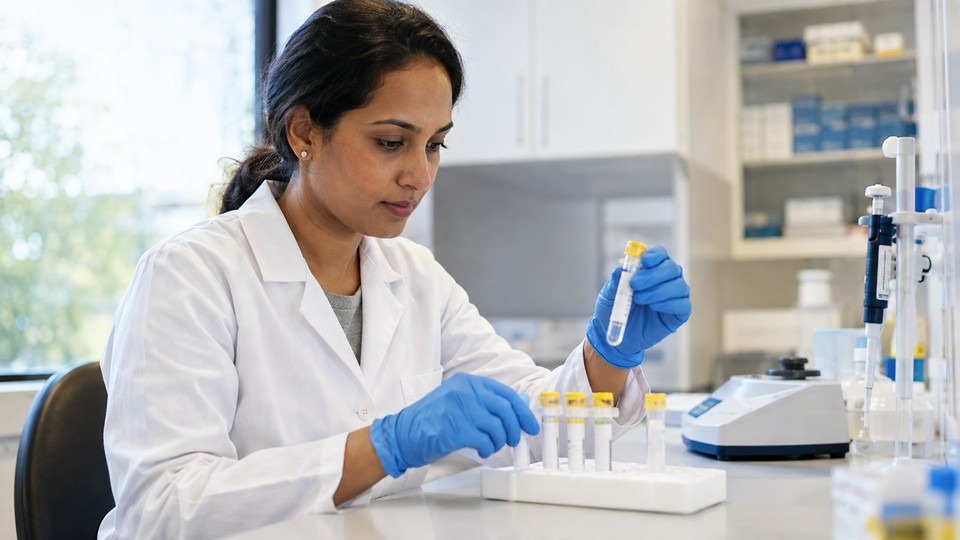
Cocaine metabolism is fast, and it explains everything else on this page. Cocaine is rapidly metabolized by enzymes in both the liver and blood. Liver carboxylesterases and plasma butyrylcholinesterase convert it primarily into benzoylecgonine and ecgonine methyl ester, which are then eliminated largely through urine.
It has a short half-life of approximately one hour, commonly cited as a range of roughly 0.5 to 1.5 hours, and is degraded by plasma esterases, the enzymes that break it down in the blood [3]. Cocaine itself is cleared relatively quickly, but not instantly. The subjective high often ends within minutes to an hour, while measurable parent cocaine can persist for hours and its metabolites can remain detectable for days.
What drug screens actually look for is what is left behind. The primary metabolite targeted by cocaine immunoassays is benzoylecgonine [2], and the body also produces ecgonine methyl ester as cocaine is broken down. These metabolites have a longer half-life than cocaine and are excreted in urine over days, which is why urine remains the standard specimen. They are not active metabolites in the sense of producing a high, so they linger in the body longer and over a longer period than any effect does; their concentrations fall over hours, but detectable metabolites can remain in urine for several days and occasionally much longer after repeated heavy use.”
When people ask what breaks down cocaine in the body, that is the answer: blood enzymes convert it within hours into compounds that then take days to clear.
This distinction matters for a practical reason. A negative test does not mean a person is not using cocaine; it may only mean enough time has passed. A positive result does not tell you how much cocaine was taken, or when, or whether the person has cocaine use disorder. Detection is a narrow measurement, and our guide to the signs of drug addiction covers the behavioral picture that actually answers the bigger question.
Cocaine Detection Times by Test Type
Cocaine can be detected for very different lengths of time depending on which specimen is collected. For the average person, the four common test types line up like this.
Urine Test
Urine is the most common specimen for drug testing. Cocaine detection in urine typically runs 2 to 4 days after use, extending to 10 to 22 days with heavy use [1]. In heavy chronic users, cocaine metabolites can remain detectable in urine for up to three weeks [2].
The wide range is the important part. An occasional user who used once over a weekend is usually clear within a few days. Someone using regularly accumulates metabolites, and the detection window stretches accordingly.
Blood Tests
Blood is a narrow window. In plasma and serum, detection times are shorter, often one to two days [2]. People taking cocaine tend to show higher concentrations in blood within minutes of use, and blood cocaine levels reflect recent use and peak concentration close to the time of use. Blood testing can document relatively recent cocaine exposure, but acute cocaine toxicity is diagnosed mainly from history, symptoms, vital signs, examination, ECG, and other clinical testing. Cocaine blood concentrations do not reliably predict the severity of intoxication.”
Saliva Tests
Saliva tests, sometimes called oral fluid tests, also detect recent use and are used less often in clinical settings [2]. A saliva sample is easy to collect under observation, which is why oral fluid testing has grown in workplace and roadside contexts, but the detection window is short, generally comparable to blood at roughly one to two days.
Hair Testing
Hair testing has a much longer detection window compared with serum or urine [2]. As hair grows, drug metabolites are incorporated into the shaft, so a hair sample taken from close to the scalp preserves a record of the preceding months. Standard hair follicle testing uses roughly one and a half inches of hair, which corresponds to approximately 90 days of growth. That is why hair tests are usually summarized as detecting cocaine use for up to 90 days.
Hair testing has limits worth knowing. It is poor at detecting very recent use, since newly grown hair has not yet emerged, and it says nothing about how much cocaine was used or when within that window.
Factors That Change Cocaine Detection Times
Two people who take the same amount can test positive for different lengths of time. How long cocaine stays in your system depends on several factors:
- How much and how often. Dose and frequency matter more than anything else. Heavy or chronic users clear metabolites more slowly than occasional users, because there is more to clear.
- Route of use. Smoking and injecting produce faster, higher peaks than snorting, which changes the shape of the curve, though all routes end in the same metabolites.
- Cocaine purity. Street supply varies, so the actual dose behind a given amount is unpredictable.
- Liver and kidney function. Metabolizing cocaine relies on enzymes and clearing metabolites relies on the kidneys. Impaired liver function or kidney function lengthens the process.
- Body composition and body fat. These influence distribution and elimination, though less dramatically for cocaine than for fat-soluble drugs like cannabis.
- Age, hydration, and general health. Individual metabolic and renal clearance can vary. Hydration can change how concentrated a urine sample is, but it does not meaningfully accelerate cocaine metabolism.
- Other substances used at the same time. Combining cocaine with other substances complicates the picture, since each drug carries its own detection window. Alcohol is the notable case: when cocaine and alcohol are used together, the body forms a separate compound called cocaethylene.
- “Using alcohol with cocaine changes cocaine metabolism and creates the longer-lived active metabolite cocaethylene. This may prolong some drug exposure, but it does not translate into a predictable extension of the standard benzoylecgonine urine-test window. The more important concern is increased cardiovascular toxicity.”That matters more than ever now that fentanyl turns up in the cocaine supply, and our chapter on how long does fentanyl stay in your system covers why that drug behaves differently.
Screening Tests, Confirmation Tests, and False Results
Not all drug screens are the same, and the difference explains most confusing results.
Screening uses lateral-flow or laboratory immunoassays, which have lower sensitivity or specificity than definitive tests [2]. These are the fast, inexpensive tests that return a preliminary positive or negative.
Confirmation uses chromatographic techniques such as gas or liquid chromatography coupled to mass spectrometry [2]. This is the definitive step, and any consequential positive result should be confirmed this way before anyone acts on it.
True positive cocaine tests can occur after legitimate medical administration of cocaine or consumption of coca-leaf tea because both involve actual cocaine exposure. Ordinary local anesthetics such as lidocaine do not appear to cause false-positive cocaine screens. [2]. That is a narrow list compared with amphetamine or benzodiazepine screens, which cross-react with a range of ordinary medications.
False negatives can occur if testing takes place outside the detection window, concentrations fall below the assay cutoff, or the specimen is unusually dilute.
Can You Flush Cocaine Out of Your System Faster?
No, and it is worth being direct about this because the internet is full of claims otherwise.
Time and your own metabolism are what clear cocaine metabolites. Laboratories can identify unusually dilute urine using creatinine and specific gravity. A dilute result is not automatically invalid; depending on the testing program and degree of dilution, it may be reported as negative-dilute or positive-dilute and may sometimes prompt recollection. Detox drinks, supplements, and home remedies have no evidence behind them. Exercise, sauna, and vitamins do not change how fast plasma esterases work.
The honest version: the only reliable way to test negative is not to use.
Cocaine Withdrawal and the Timeline After Stopping
There is a third timeline people conflate with the first two: how long it takes to feel normal again. Cocaine withdrawal symptoms can begin within hours of the last use, typically peak over the first one to three days, and include fatigue, heavy sleep, depression, irritability, and intense cravings. Mood disturbance and cravings can persist for weeks after the acute phase passes, long after any test would come back positive.
That mismatch is worth understanding. Being clear on a drug screen and feeling well again are not the same milestone, and expecting the second to arrive with the first is a common reason people give up early.
How Long the Effects Last Is a Different Question
People often conflate two timelines: how long the effects of cocaine last, and how long the drug remains detectable. The high from snorting powdered cocaine lasts roughly 15 to 30 minutes, and smoking crack cocaine shortens it to 5 to 10 minutes [4]. The drug’s effects are over in under an hour. The metabolites stay for days.
That gap is exactly why cocaine use is easy to miss in a household and hard to hide from a laboratory, and it is worth keeping straight when you are trying to work out what you are seeing. Our chapter on the signs of cocaine use covers what the short window of intoxication actually looks like.
The Question Underneath the Question
Many people searching this do not have an academic interest in pharmacokinetics. They are either worried about someone else, or they are timing their own use around a test.
If it is the second one, that is worth sitting with. Trying to time cocaine use around a drug test can be a reason to reflect on the role the drug is playing, but that behavior alone does not establish cocaine use disorder. Diagnosis depends on the full pattern of control, cravings, consequences, priorities, tolerance, and withdrawal.
Loss of control, continued use despite consequences, and rearranging life around a substance are among the clinical criteria for cocaine use disorder, and planning around a test touches at least one of them. The question is not whether you can time it correctly. It is why you have to.
It is also worth naming what a test does not measure. A drug screen says nothing about high blood pressure, cardiac strain, liver damage, or the psychological symptoms that come with sustained use, and it cannot tell you whether someone is at higher risk of a life-threatening event the next time they use. Those are the questions a clinician can actually answer, and a specimen cannot.
If it is the first, and you are trying to establish whether someone is using, a test is weaker evidence than you might hope. Behavior over weeks tells you more than a specimen does. And if the substance in question might not be cocaine at all, our chapters on the signs of meth use and the signs of heroin use describe what those look like instead.
Cocaine Addiction Treatment and Getting Help

If detection windows are on your mind because cocaine use has become a pattern, the useful next step is an assessment rather than a calculation. Cocaine abuse and cocaine addiction are the terms most people search; addiction treatment professionals call it cocaine use disorder, and drug abuse of any kind is diagnosed by the relationship with the substance rather than by a test result.
There is no FDA-approved medication specifically for cocaine use disorder, so evidence-based behavioral treatment remains central. Addiction specialists may also consider certain medications off-label for selected patients [4]. Cocaine withdrawal is not usually medically dangerous, which means outpatient treatment fits many people well.
Simple Path Recovery provides partial hospitalization and intensive outpatient programs in Pompano Beach with day and evening schedules, family therapy, and integrated care for co-occurring mental health conditions. We do not provide detox or residential treatment, and when someone needs either first, we help the family find it.
How Long Does Cocaine Stay in Your System FAQs
How Far Back Does a Urine Test Show Drugs?
For cocaine, a urine test generally reaches back 2 to 4 days, and 10 to 22 days after heavy use [1]. Other drugs differ substantially: benzodiazepines run 1 to 3 days and up to six weeks with heavy use of long-acting compounds, and cannabis runs 1 to 3 days for infrequent use and up to 30 days with chronic use [1].
What Breaks Down Cocaine in the Body?
Cocaine is metabolized rapidly by enzymes in the liver and blood, particularly liver carboxylesterases and plasma butyrylcholinesterase. Its elimination half-life is roughly one hour, meaning its concentration falls by about half during that period rather than disappearing completely. The parent drug disappears quickly; the metabolites are the trail.
How Long Does Cocaine Stay in Your System if You Only Used Once?
For a single use by an occasional user, urine will typically be negative within 2 to 4 days [1]. That said, a one-time use is rarely the reason someone is asking, and the pattern matters more than the timeline.
If reading this has raised a question you would rather not sit with alone, that is a reasonable moment to ask someone. Drug and alcohol rehab at Simple Path Recovery in South Florida offers confidential assessments and day and evening outpatient programs, and nothing about a conversation commits you to anything.
Sources
- Urine Drug Testing Window of Detection (table), NCBI Bookshelf, National Library of Medicine: https://www.ncbi.nlm.nih.gov/books/NBK574915/table/p5.t2/
- Clinical Drug Testing, StatPearls, NCBI Bookshelf, National Library of Medicine: https://www.ncbi.nlm.nih.gov/books/NBK557523/
- Cocaine, StatPearls, NCBI Bookshelf, National Library of Medicine: https://www.ncbi.nlm.nih.gov/books/NBK430769/
- National Institute on Drug Abuse, Cocaine DrugFacts: https://nida.nih.gov/publications/drugfacts/cocaine
- Substance Abuse and Mental Health Services Administration, National Helpline: https://www.samhsa.gov/find-help/helplines/national-helpline